
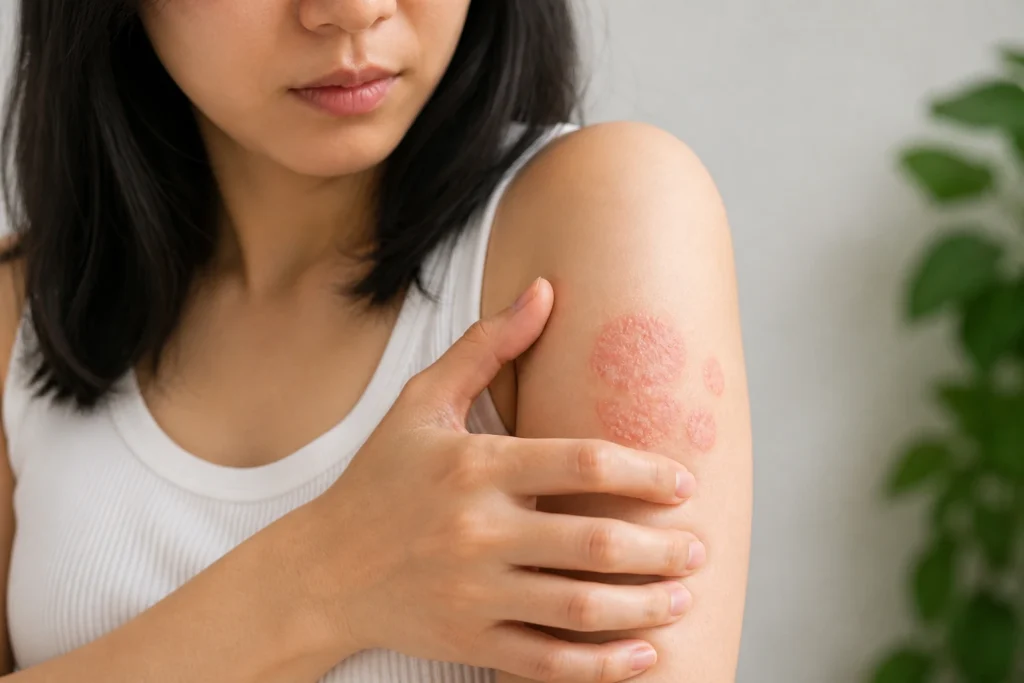
Nummular eczema is named after the Latin word for coin, describing the round, well-defined patches of irritated skin it produces. These patches can appear suddenly after a skin injury, during a period of very dry weather, or without any obvious trigger at all. Once formed, they are intensely itchy and slow to heal without the right skincare approach.
This guide covers what causes nummular eczema, how to recognise it, and the skincare strategy that soothes patches and reduces how often they return.
Key Takeaways
- Nummular eczema produces circular patches of red, scaly, or crusting skin that weep and itch intensely
- It is most common on the lower legs, torso, and backs of hands
- Dry skin, skin injuries, and harsh cleansing products are the three most consistent triggers
- Daily moisturising with barrier-repairing ingredients is the most evidence-supported long-term management strategy
- Goat milk body care provides pH-matched cleansing and fatty acid-rich moisturising proven to reduce eczema patch incidence
Table of Contents
- What Is Nummular Eczema?
- Symptoms and Appearance
- What Causes It?
- Triggers to Avoid
- Soothing Skincare for Nummular Eczema
- Best Ingredients for Patch Management
- A Practical Daily Routine
- Frequently Asked Questions
What Is Nummular Eczema?
Nummular eczema (also called nummular dermatitis or discoid eczema) is a subtype of eczema defined by its distinctive coin-shaped lesions. The patches typically measure 1 to 10 centimetres across and can appear singly or in clusters. While atopic eczema often affects the skin folds, nummular eczema favours the limbs and trunk.
The condition affects adults more than children and tends to be a chronic, relapsing condition. A study published in the American Journal of Clinical Dermatology estimated that nummular eczema accounts for approximately 9% of all eczema diagnoses in dermatology clinics. It is often underdiagnosed because its round patches are frequently mistaken for ringworm, psoriasis, or contact dermatitis.
Symptoms and Appearance
Nummular eczema patches go through recognisable stages. Knowing these stages helps you identify the condition early and respond before patches become entrenched.
Stage 1: Acute (0 to 2 weeks)
- Clusters of small, fluid-filled bumps (papules and vesicles) appear on the skin
- The bumps merge into a coin-shaped area of redness and swelling
- Oozing of clear or yellowish fluid, particularly after scratching
- Intense itch that tends to worsen at night
Stage 2: Subacute (2 to 6 weeks)
- Patch dries out and becomes scaly or crusty on the surface
- Colour changes from bright red to a duller pink or brown
- Itch may decrease but the patch remains defined and tender
- Scratching re-opens the surface, restarting the oozing cycle
Stage 3: Chronic or Healing (6 weeks and beyond)
- Patch becomes thickened and leathery in texture (lichenification) if scratching has been frequent
- Central clearing may occur, giving the patch a ring-like appearance
- Residual darkening or lightening of skin (post-inflammatory dyspigmentation) after the eczema clears
What Causes Nummular Eczema?
Nummular eczema is driven by a breakdown in the skin barrier combined with immune dysregulation. When the barrier fails, the skin loses moisture rapidly (a process called trans-epidermal water loss) and becomes vulnerable to irritants, allergens, and microbial colonisation. This triggers an inflammatory response that produces the characteristic patches.
Research from the British Journal of Dermatology shows that people with nummular eczema have significantly lower levels of ceramides and natural moisturising factors in their skin barrier compared to people without eczema. Ceramides are the lipid molecules that make up approximately 50% of the skin barrier’s protective structure. When ceramide levels drop, barrier integrity fails and patches become more likely to develop.
Specific Causes
- Previous skin injury: Insect bites, burns, abrasions, and surgical scars are common sites where nummular eczema patches begin
- Chronic dry skin: The most consistent predisposing factor across all age groups
- Bacterial colonisation: Staphylococcus aureus is found on nummular eczema patches at significantly higher rates than unaffected skin, and may contribute to both triggering and perpetuating patches
- Medication side effects: Certain medications including isotretinoin, interferon, and some cholesterol-lowering drugs are associated with nummular eczema onset
- Venous insufficiency: Poor circulation in the legs increases the risk of nummular eczema developing on the lower limbs
Triggers That Make Nummular Eczema Worse
Identifying and removing triggers does not cure nummular eczema, but it dramatically reduces flare-up frequency and severity. The most consistent triggers across clinical studies are:
- Soap and conventional body wash: Products with SLS, SLES, and alkaline pH destroy the skin’s acid mantle, accelerating barrier failure
- Fragrances: Both synthetic and natural fragrances are among the most common contact allergens and direct irritants for eczema-prone skin
- Hot showers: Water above 38 degrees strips sebum from the skin surface, removing the protective lipid film that slows water loss
- Wool and synthetic fabrics: Rough or non-breathable fabrics mechanically irritate existing patches and prevent healing
- Stress: Elevated cortisol directly suppresses skin barrier function and increases inflammatory cytokines that drive eczema flares
- Alcohol in skincare: Dehydrates the outer skin layers and disrupts barrier lipid organisation
Soothing Skincare for Nummular Eczema
Soothing nummular eczema is not about a single miracle product. It requires a cleanse-and-moisturise system that works together to stop barrier damage at the source and repair what has already broken down. Getting either step wrong will undermine the other.
Step 1: Cleanse Without Stripping
The cleansing step is where most people with nummular eczema unknowingly cause damage. Conventional body washes strip the skin’s natural lipids and raise its pH above 7, creating the exact environment in which eczema patches thrive. A clinical comparison study showed that skin washed with alkaline soap loses 20% more moisture in the three hours following bathing compared to skin washed with a pH-balanced cleanser.
Goat milk body wash has a natural pH of 6.4 to 6.8, which is close to healthy skin’s optimal pH of 5.4 to 5.9. This means cleansing with a goat milk formulation does not trigger the post-wash moisture loss that conventional products do. The lactic acid in goat milk also gently removes dead skin cell buildup from patch surfaces without abrasion or disruption to the living skin beneath.
Step 2: Lock Moisture In Immediately After Bathing
Moisturiser must be applied within three minutes of bathing, before the water evaporates from the skin surface. The “soak and smear” technique, endorsed by the American Academy of Dermatology for eczema management, recommends applying emollient immediately after patting skin dry to lock the residual moisture into the skin rather than letting it evaporate.
The Yagishi Premium Goat’s Milk Body Lotion is formulated specifically for this role. It combines goat milk (fatty acid barrier replenishment), niacinamide (stimulates ceramide synthesis by up to 34%), and panthenol (pro-vitamin B5, accelerates skin cell renewal) in a formula free from alcohol, mineral oil, parabens, and SLS. Verified customers with chronic nummular eczema report visible improvement in patch size and itch intensity within two to four weeks of daily use.
Best Ingredients for Nummular Eczema Skincare
| Ingredient | What It Does | Evidence Level |
|---|---|---|
| Goat milk | Restores barrier lipids, provides lactic acid exfoliation, pH-matched to skin | PMC-indexed clinical trials |
| Niacinamide | Increases ceramide production by up to 34%, reduces redness and inflammation | Journal of Cosmetic Dermatology |
| Panthenol (B5) | Accelerates wound healing, reduces trans-epidermal water loss | Multiple RCTs |
| Glycerin | Draws water from deeper skin layers to the surface (humectant) | Widely validated |
| Aloe vera | Anti-inflammatory, cooling effect on itchy patches | Cochrane-reviewed |
| Colloidal oatmeal | FDA-recognised skin protectant, reduces itch and inflammation | FDA-approved |
A Practical Daily Routine
Consistency is more important than product quality alone. A basic routine done every day outperforms an elaborate routine done intermittently.
Morning (5 minutes)
- Skip the second shower if you showered the night before
- Apply a thin, even layer of body lotion to all affected areas and the skin around them
- Wear loose, cotton clothing over active patches to reduce friction and prevent scratching during the day
Evening (10 to 15 minutes)
- Shower in lukewarm water (below 38 degrees) for no more than 10 minutes
- Use a pH-balanced, SLS-free, fragrance-free body wash, applying gently with hands rather than a rough loofah
- Pat skin dry gently with a soft towel within one minute of finishing the shower
- Apply body lotion within three minutes, focusing on patches and any historically dry areas
- Apply any prescribed topical treatment on top of the moisturiser if directed by your doctor
Frequently Asked Questions
Is nummular eczema the same as discoid eczema?
Yes. Nummular eczema and discoid eczema refer to the same condition. “Nummular” is derived from Latin meaning coin-shaped, while “discoid” comes from Greek meaning disc-shaped. Both terms describe the same pattern of coin-shaped inflammatory patches. The two names are used interchangeably across dermatology literature and medical settings.
How do I know if my patch is nummular eczema or ringworm?
Ringworm tends to have a more clearly defined raised, scaly outer ring with a relatively clearer centre, while nummular eczema patches are uniformly inflamed throughout. Ringworm also spreads outward progressively and responds to antifungal treatment within two weeks. If an antifungal cream has not reduced your patch after two weeks, see a doctor for a confirmed diagnosis before trying other treatments.
Why does my nummular eczema keep coming back in the same spot?
Once a nummular eczema patch develops, the local skin barrier in that area is more vulnerable to future breakdown. The residual post-inflammatory changes and subclinical barrier dysfunction make the same spots more susceptible to flares when triggers are present. Consistent moisturising of previously affected areas, even after patches have cleared, significantly reduces the likelihood of recurrence in the same location.
Can stress cause nummular eczema to flare?
Yes. Psychological stress triggers the release of cortisol and inflammatory cytokines (including interleukin-31 and substance P) that directly suppress skin barrier function and increase itch signalling. Clinical studies show that nummular eczema patients report significantly more flares during periods of acute stress. Managing stress through consistent sleep, exercise, and mindfulness practices reduces flare frequency alongside skincare management.
How long does a nummular eczema patch take to clear?
With appropriate treatment (topical corticosteroids for active patches) and consistent daily moisturising, most patches reduce significantly within two to four weeks. Complete clearing of the patch and surrounding discolouration typically takes two to three months. Without treatment, patches can persist for months or years, particularly if the trigger has not been identified and removed.
Conclusion
Nummular eczema is frustrating because patches are slow to heal and quick to return when skincare is inconsistent. But the management strategy is clear: stop the barrier from breaking down by switching to pH-balanced, SLS-free cleansing, and repair it daily with a ceramide-stimulating, fatty acid-rich moisturiser applied immediately after bathing.
See a dermatologist for patches that are weeping, spreading, or not responding to skincare changes within four weeks. For ongoing prevention and daily barrier support, the right body wash and lotion combination is the most practical and evidence-backed tool you have.